»
Our Coffees

»
Characteristics
Explained
» The 4 Basics For Great Coffee
» Home Page
E-mail: sales@twinsprings.net
|  |
COFFEE PRODUCTS |
|
|
|
|
|
|
|
Single - Origin Varieties |
Description |
Flavor |
Aroma |
Balance |
Body |
|
|
|
|
|
|
|
| Andes |
Dark Roast |
Extreme Height of Richness |
Rich & Delicate |
Fragrant, Rich & Smooth |
Medium to High |
Light |
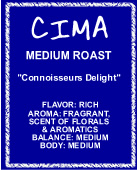
| Cima |
Med Roast |
Connoisseurs Delight |
Rich |
Fragrant, Scent of Florals & Aromatics |
Medium |
Medium |
| Cuesta |
Light Roast |
Greatest Of The Great |
Agri Sweet |
Deep Scent of Aromatics |
Medium |
Medium to Light |
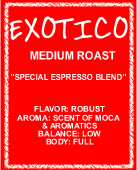
| Exotico |
Med Roast |
Special Espresso Blend |
Robust |
Scent of Moca & Aromatics |
Low |
Full |
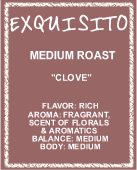
| Exquisito |
Med Roast |
Clove |
Rich |
Fragrant, Scent of Florals & Aromatics |
Medium |
Medium |
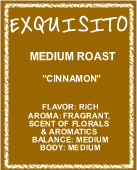
| Exquisito |
Med Roast |
Cinnamon |
Rich |
Fragrant, Scent of Florals & Aromatics |
Medium |
Medium |
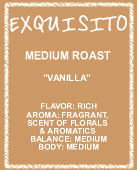
| Exquisito |
Med Roast |
Vanilla |
Rich |
Fragrant, Scent of Florals & Aromatics |
Medium |
Medium |
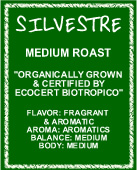
| Silvestre |
Med Roast |
Organically Grown & Certified
By ECOCERT BIOTROPICO |
Fragrant & Aromatic |
Aromatics |
Medium |
Medium |
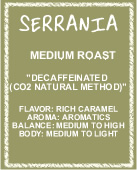
| Serranía |
Med Roast |
Decaffeinated (CO2 Natural Method) |
Rich Caramel |
Aromatics |
Medium to High |
Medium to Light |
100% COLOMBIAN COFFEE |
SAMPLE LABELS |
|
| |
| |
|
Characteristics
Explained:
Aroma is the first hint of how your coffee
will taste. In fact, most of your sense of taste actually comes
from your sense of smell - which is why coffee can taste so satisfying
and sublime.
Acidity / Balance, in tasting terms, doesn't
mean sour or bitter; it's a lively, tangy, palate-cleansing property,
ranging from low to high. Think of the range from still water
to sparkling water, and you'll get the idea.
Body is the weight or thickness of the
beverage on your tongue. Body ranges from light to full.
Flavor is the all important melding of
aroma, acidity / balance, and body that creates an overall impression. Ultimately,
tasting is comparing and contrasting. Tasting only one coffee
at a time does not create any context. But if you taste two or
three coffees, you can compare them in terms of your personal
preference, but also in terms of aroma, acidity / balance, body,
and flavor. (A tip: When tasting more than one coffee, always
taste lighter bodied coffees first and work up to fuller bodied
coffees).
The
Four Basics For Great Coffee: The
recipe for a great cup of coffee Proportion, Grind, Water and
Freshness. Understand and follow the guidelines for each of them,
and you're on your way to brewing a great cup of coffee every
time.
Proportion
Use the right proportion of coffee to water This is the most important
step in making great coffee. For the most flavorful cup of coffee,
our growers recommend two tablespoons of ground coffee (10 grams)
for each six fluid ounces (180 milliliters) of water. If coffee
brewed this way is too strong for your taste, you can add a little
hot water to your cup of brewed coffee.
Grind
The shorter the brewing process, the finer the grind. Different
brewing methods have different grind requirements, so grind your
coffee for the brewing method you use. The amount of time the
coffee and water spend together affects the flavor elements that
end up in your cup of coffee, and the design of your coffee maker
dictates how long the coffee and water sit in direct contact during
the brewing process. For instance, coffee ground for an espresso
machine should be very fine, in part because the brew cycle is
only 19 to 22 seconds long. But for a coffee press, the coffee
should be coarse ground, because the water and coffee are in direct
contact for about four minutes.
Water
Use fresh, cold water heated to just off the boil A cup of coffee
is 98 percent water. Therefore, the water you use to make coffee
should taste clean, fresh, and free of impurities. Water heated
to just off a boil (195° to 205° F or 90° to 96° C) is perfect for extracting the coffee's full range of flavors.
Any cooler and the water can't adequately do the job. Automatic
coffee makers heat the water for you. Make sure the one you use
gets the water hot enough.
Freshness
Use freshly ground coffee Think of coffee as fresh produce. The
enemies of coffee are oxygen, light, heat, and moisture. To keep
coffee fresh, store it in an opaque, airtight container at room
temperature. Storing coffee in the refrigerator or freezer for
daily use can damage the coffee as warm, moist air condenses to
the beans whenever the container is opened. For the best results,
coffee should be ground just before brewing. Whole bean coffee
stays fresh longer because there is less surface area exposed
to oxygen. By grinding beans each time you brew, the freshness
is preserved. Additionally, the person making the coffee will
enjoy the freshness as the grinder releases the aromas inside
the bean.
|